Today he is the damn cat. Last night he woke me up throwing up next to the bed. This morning he was annoying enough to get me out of bed - I thought he wanted breakfast. No, he wanted to go outside and eat grass so he wouldn't throw up inside. I didn't understand. He threw up inside. Then I let him out and he ate grass.
He is an indoor cat and he has a plant pot that is growing grass for him on the window sill. But grass is better on the outside. However he can be very determined.
He is also approaching the ripe old age of 19. He can't hear - we can tell because he is no longer capable of walking quietly. Nor can he tell how loudly he meows at us. He can't see. We can tell this because I can wave my arms at him across the room and he can't find me. He can't really smell. We can tell this because he can't find food unless it is right under his nose.
He also has swollen ankles on his back legs where it looks like some kind of arthritis but it doesn't seem to bother him much. His coordination is bad - we can watch him slide off the edge of the coffee table, miss the edge of the sofa when he tries to get up on it, and all sorts of other things that impair his dignity.
He was REALLY mad at us when we left him on vacation. He had a live in baby sitter who fed him and took care of him. He stopped eating for a few days and left a few presents around the house.
But he is very cuddly. Its now fall. I can tell because he sleeps next to me and I appreciate it now. When it was hot out, I didn't appreciate it as much.
He was also my chemo buddy and whenever I am not feeling well, he follows me around to take care of me with his snuggles.
That is life with the damn cat. It definitely has its ups and downs.
There is all this talk these days about what you can do to reduce your risk of cancer, dementia, chicken pox, or the common cold, among a million other things. You know all the advice - eat broccoli, exercise, don't drink, lose weight, exercise, eat margarine no eat butter, drink red wine no white - and all it does is confuse the crap out of us.
Then they start to give people personal risk assessment for an ailment and expect us to believe them. How much conflicting medical advice do you hear on a given day? A lot. Eat red meat and chocolate, no don't, yes, well a little, and the famous words - in moderation. How can you be expected to believe anything?
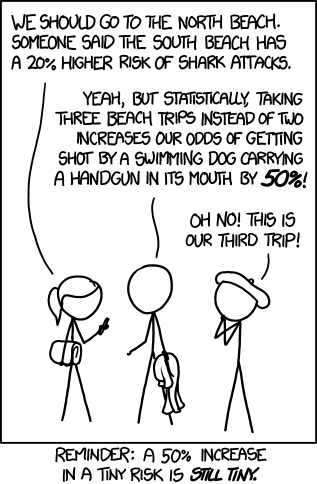
When you are told what your risk of some thing is - whether being diagnosed with cancer or being hit by lightening, don't you always harbor that little thought in the corner of your brain that of course they are only talking about other people and not you or anyone you care about. Its always going to affect those other faceless people you don't know.
So why all the surprise when a new study shows that one in five women don't believe their breast cancer risk? I can honestly tell you I was very surprised by both my cancer diagnoses. I thought my back pain was the result of muscle strain and not the permanent debilitating state of the disks in my spine. I thought my aches and pains that turned out to be rheumatoid and fibromyalgia were just normal aging.
Sometimes I think, they were all wrong and I am really a healthy person who can live the way I used to - working full time, having a social life, and going off on adventures regularly that involve beaches, mountains, and the great outdoors.
Seriously, we hear so much conflicting medical advice and then if someone gives us a risk assessment, we are supposed to believe them? I think a risk assessment is like listening to the weather forecast - there is a good chance Saturday will be rainy and it should clear out for Sunday but watch out for a hurricane next week. How do they really know?
Some days I actually write a profound blog post that is coherent and other people read and share. Today is not one of those days. My brain is full and I haven't even left for work yet and here is why:
Weather: Tonight's low is going to be down around 50 - this means I need to start bringing in some plants from outside - particularly my Ponderosa lemon and my Key lime plant. They are just starting to produce fruit and I want to be able to enjoy them. But they are tropical plants and aren't supposed to be out in temperatures anywhere in the 50s. There are even some frost/freeze warnings near by.
Its New England and the summer was unplugged last weekend - it was Labor Day. Time to think about snow shoveling, raking leaves, and (brace yourself) winter. Never mind that summer doesn't really start around here until mid-June.
Flabbiness: While I didn't gain or lose weight on vacation, I came back with a vow to stop snacking at work (where there are always snacks). That lasted about two hours. I have to reinforce my will power or I will never lose weight.
Birthdays: What the hell to buy for my husband for his birthday next week? I have some ideas but he is difficult to buy for to say the least. And what to do to celebrate his birthday. Damn. I'll have to figure this one out.
Work: I'm buried. I was out for two weeks and my in box filled up as my brain emptied out while I was away. And I am getting no sympathy because I am taking another week off at the end of the month.
Crafting: My knitting is burying the house. I need to start finding places to sell it all. But first I need to finish projects, block them, and label them all. Crap.
And I have four more weeks until another doctor appointment.... (insert tiny cheer here)
See nothing profound here today. I'll try to be more profound by tomorrow but don't hold your breath.
With a cancer, or other 'icky', diagnosis, life has significant ups and downs. Sometimes people want support and sometimes they want privacy. It depends on lots of things - patient and family member's personality, type of diagnosis, current state on the medical roller coaster, among other issues. So the outsider is left to figure out when to intrude and when not to.
I have a friend who is coping with her husband's Stage IV cancer diagnosis and on-going treatment. It is hard to get together with her these days as she can't tell day by day how he will be doing and if she will be comfortable leaving him. We communicate by email and try to set up times to get together - which sometimes it takes months to meet.
Another friend has a long term friendship with another couple who have suffered a horrible family tragedy last year and now the wife is dealing with metastases in her Stage IV cancer diagnosis. They are normally a very private couple and usually keep their personal issues quiet. The husband sent my friend an email about his wife's disease progression.
My thought is that this is a cry for help and I think my friend should call them up and offer to bring lunch on Saturday or something so they can get together. If they are opening up at this horrible time in their life, it is a request for support that they know my friend can provide through her own experiences and their long term friendship.
My friend, on the other hand, isn't so sure and thinks they would not want the intrusion. She knows them and I don't so perhaps she is correct here. But it is very hard to tell in these situations
When is it time to intrude and when is it time to honor their privacy. This goes beyond the issue of hospital visits that I blogged about the other day.
Many patients with icky medical diagnosis set up ways to control communication so they are not overwhelmed - whether a blog (like me), a web page, Facebook page, Twitter feed, or email blasts. It can be very difficult to control the communication flow. How to balance the latest medical information, need for privacy, and over anxious friends and family members is a huge problem for many patients.
The last thing many patients need is daily phone calls from the same people asking for the latest updates - what did the doctor say, what did your scan show, are you worried, how are your children coping - have you told them yet, and a slew of other questions that pressure the patient to share when they may not be ready to do so. And if there are repeated requests over and over the patient's stress mounts at an already stressful time.
A patient's right to privacy must be respected but sometimes they do need some support. The tricky part is figuring out when to intrude.
As I approach my one year anniversary of being diagnosed with rheumatoid arthritis and fibromyalgia (because I didn't have enough ailments prior to then), I can reflect back. Although my mother has had RA for more than 20 years and I thought I was fairly educated on the subject, its different when you are the one living with the disease.
To be fair, I will say I had long since moved out of my parent's house when my mother was diagnosed so I was exposed to less of the day to day issues. For many of those years, I was busy with a career which involved lots of travel and pressures. But now that it is affecting me, I find I have learned a lot more.
I do not know what the standard protocols were for treating RA when she was diagnosed in 1989, but now the protocol is to treat it strongly and quickly to prevent many of the side effects and degeneration that accompanies the disease.
I was promptly put on prednisone for the short term, as a quick acting treatment, and plaquenile, as a long term treatment, and found out I was allergic to both. Then I was switched to methotrexate oral, dose upped, and finally switched to injections in the spring. That was until my compromised immune system caused my husband's mild cold to give me a double ear infection and put me out of circulation for two weeks while I recovered. I had to go off methotrexate to treat my ear infections with antibiotics.
Finally, I have been back on weekly injections for about six weeks and am starting to feel normal, or as normal as I ever will be, again.
Over the year, I have learned all sorts of fun things about RA and how it affects the body:
Its not just the disease but the treatments that can cause problems with your skin - ones I have include Raynaud's syndrome, bruising, red dots, and increase sun sensitivity.
My favorite is how RA affects both your hands and feet.
And the treatment for fibromyalgia? Its just treating the pain so we are trying to manage that. But now I have both fibro fog and chemobrain so I can claim brainlessness regularly. I have problems remembering words and names these days and am constantly misnaming things and people.
What do I have to look forward to with RA and fibro? I have blood tests every eight weeks to monitor my blood levels, particularly liver function as methotrexate is hard on your liver. I bruise very easily and every cut, scrape, or bruise takes forever to heal.
In the meantime, as life gives me lemons I keep on working on that lemonade.
This morning's news includes a story on a gentleman with stage IV esophageal cancer who is disputing with his insurance company to cover the costs of his treatment. He is treated at Dana Farber and is pursuing alternative treatments. I am fully supportive of efforts to prevent insurance companies from making medical decisions.
Also, I am a big fan of preventing bloated insurance costs where people expect everything to be covered and then can't understand why their premiums keep going up in leaps and bounds. There has to be a happy medium while is why insurance companies need to be allowed to draw the line somewhere.
As you are aware, I do not believe insurance companies are capable of making individual medical decisions. They may employ their own oncologists and other doctors to review decisions. But unless the doctors have met with the patient and examined them, they have no idea what they are doing. At the very least the patient's doctors recommendations should be the guidelines followed. Not someone who is reading an actuarial guide and cost/benefit analysis. That is no way to make a decision that might permanently affect some one else's life.
However, and this is a big fat HOWEVER, if the treatment has not been shown to have any proven results I do not believe the insurance providers should be required to cover it.
There are all sorts of quackery theories on curing cancer and myths about treating and curing cancer. There are also many alternative treatments that are not necessarily covered by insurance but have proven to be beneficial to cancer and other patients. This would include things like acupuncture.
The problem with this gentleman's request is that he is asking for coverage for something called Insulin Potential Therapy or IPT. I googled it and the first two results were from Quackwatch.org and from the American Cancer Society showing that their was no real proof it works.
While I understand he is fighting for his life, I am actually on the side of the insurance company here. The treatment he wants has not been shown to be effective. He has a full medical team available to him where he is being treated. While he may be feeling better currently, there is no way to tell if it can be attributed to the IPT or some other reason.
As we approach the month of Pinktober (with 30 days advance notice), it is time for all of us to raise our hands and pledge the following. Please join in.
Raise your right hand and repeat after me:
I (state your name [and not the Animal House version]) promise that during the month of Pinktober, formerly known as October, I will not arbitrarily purchase pink items or donate to pink causes with out first researching how much actually goes to breast cancer research or screening services.
I will first research them using services such as Charity Navigator (www.charitynavigator.org) to ensure they are legitimate. I also promise that I will not support pinkification efforts to paint things pink, light up buildings in pink, or other such activities.
Thank you.
We need to focus our efforts on research and screening services for under served populations. We do not need any more awareness. The American public is plenty aware of breast cancer at this point.
Between now and then September is Prostate Cancer, Childhood Cancer, Thyroid Cancer, Leukemia and Lymphoma, and Ovarian Cancer month. It also contains the Jewish holy days of Rosh Hashana and Yom Kippur. Those all seem to be overshadowed by the looming Pinkification of October.
In October, there are other lovely holidays to support. Halloween for one - the one where we dress in costume and eat lots of candy, never mind Columbus Day and a host of other minor celebrations.
November includes many events including Veterans Day and Thanksgiving but it in recent years the squabbling that has resulted from Pinktober overwhelms everything until Thanksgiving. It also includes the great American Smokeout, Lung Cancer Awarness and Pancreatic Cancer awareness month.
What I am trying to say is stop supporting on pinkification and focus on research and screening for underserved populations.
Recently UPS was criticized for dropping employee health insurance coverage for spouses who are eligible for health insurance through their employers. But that's only 15,000 people. The majority of their drivers and other employees are covered through Teamster's Union benefits so they will not be affected by the change.
A recent article called Employers Play Obamacare Blame Game discusses reactions to the shared costs complaints and how other companies are reacting to the upcoming changes.
The whole point of mandatory health care is to have a healthier population. This requires change. So of course employers are going to start shifting burdens around as much as they can. Companies which have provided the most benefits I am sure will be some of the first to start making changes.
There is a separate requirement, starting in 2018, where employees who offer richer policies will be required to start shifting more of the costs to employees or start paying a penalty.
People are dying or going bankrupt due to lack of medical care or the high costs associated with it. We need to share the burden and can't assume our employers or the government will hand us everything we need. Its part of taking our place in society and being a contributing human being.
There are those, including me, who face health or other issues, who can't contribute as much as others. But that doesn't make them any less of human beings. If you do not like the current and upcoming changes for whatever reason, then you can do your part by cooperating with the existing legislation and work to find ways to change it.
What this is all called is change. Get over it. Change is needed to make health insurance more affordable and health care more available. Our current system does not work. Insurance companies, not doctors, are making decisions about the health of people.
Here's a theory: skip focusing on which diet is best and start focusing on changing eating habits.
This translates to stop focusing on what we eat and getting the balanced diet and change to focus on how we can get people to make healthier food decisions. Are we eating because we are stressed? Do we have bad habits related to the drive through where we make a quick stop on the way home and eat the food in the car?
Researchers look at all sorts of diets - Paleo, Atkins, Weight Watchers - and compare them all. The FDA issues the nutrition pyramid which is now a plate. But does anyone stop and look at the eating habits we have developed and why we have them?
We live in a world full of light this and fat free that and a widening population. Why?
I used to work with a woman who was a fairly healthy eater at work. She did not snack, she didn't go out for donuts. But she was quite large. I never really figured out why.
Then I went on a business trip with her and she insisted we stop at the grocery store on the way to the hotel so she could get some stuff for her room. I was happy to go and get some seltzer (my secret addiction). She bought a couple boxes of crackers and cookies - for a three day business conference. I think she went out and made another grocery run later on. I think she was an evening snacker - hence her hefty weight.
So why does a normal, bright, well educated person, sit and eat for hours at night by themselves? That is the question to answer.
If you watch the greater loser shows, people talk about their bad eating habits and are taught how to eat healthy - no soda, no drive through, healthy snacking. They also get exercise and lose weight. But they change their eating habits. Maybe they eat more salads and fewer french fries but often these shows are accompanied by tears and emotional breakthroughs as well.
I know my weight stems from three issues I have.
At my job, there are more snacks than any place I have ever worked and the kitchen is right next to my office.
I snack after dinner which I shouldn't do. (Why did I eat that granola bar after dinner last night? I didn't have dessert is my justification and I wanted something crunchy. But I didn't need it.)
Sometimes I eat when I am not hungry because I am bored, stressed or in pain.
So if I can get rid of those habits, I can lose weight. I have been working on them, my weight is going in the right direction. The funny thing is I am still eating desserts sometimes and normal food. I didn't switch what I eat. I switched when I eat. My goal is to modify my eating habits so I can get to and maintain a healthy weight but still enjoy eating. I will no live on lite versions of crappy prepared food.
Maybe that's what researchers need to figure out so other people can more easily lose weight.
When I am hospitalized, I have a list of people who can visit me. They include my husband, my parents, and my siblings. Anyone else has to call and ask. I am serious about this. If people visit unannounced, they will find out how rude I can really be.
My strong feelings about this are due to the fact that once, after a significant surgery, a friend had to stop at the hospital for an early morning appointment, the day after my surgery. So she decided to stop by my room at 830am. I was not ready for guests.
I was talking to someone who was a friend and a nurse who was giving me some information. I did not want to socialize. She didn't understand the concept of good manners and to think that the morning after major surgery might be a bad time to visit someone.
When I am in the hospital:
I probably feel like crap.
I probably look like crap.
I am probably cranky.
Its not that I don't want visitors at all - they do help the time go by - but my goal is to get better enough so I can leave as soon as possible. If I can't get my naps in, I won't be able to get better. I find the concept of visiting people in the hospital for hours on end to be a bit ridiculous.
I actually feel sorry for the patient's whose families come to visit and stay for hours in big groups. If you are sick enough to be in the hospital, you don't want to host a party, you probably want to take a nap.
There is a hospital in Hawaii which has started the policy of visiting hours 24/7 and let the patients set their visiting times. This was done at patient request citing a study that found that people surrounded by family and friends heal faster and cope with their hospital stay better.
At first I was pretty appalled by this. But then I started to think.
There are lots of people who work odd shifts or have child care issues or travel distances or work nights and I can go on and on that have off hour schedules normally and are used to getting a lot of sleep during the day wherever they are so why should hospital visitation be any different?
Hospitals are where they wake you up for a sleeping pill or to take your blood and vital signs at 2am. So you might as well have a friend hang out with you for it.
Most people you meet, you generally don't share lots of private information until you have gotten to know them. Your doctor is different. You go see a new doctor for whatever reason and then you start spilling your guts on the state of your gut and other body parts.
If you think about it they are a stranger. I sometimes have to scrape doctors off the floor when I start telling them about my issues and allergies - they all love the fact that I am allergic to benadryl. I have had them start laughing too - with me, not at me.
But it is all about trust. How much do you really trust a stranger?
I think we believe doctors are ethical and honest human beings, with the best interests of the patient in mind. Personally I believe people are honest and ethical for the most part and don't start to lose trust unless I feel betrayed.
I don't mind if my doctors talk about me together in order to figure out how to best treat me. But I would be really upset if my doctors were trying to scam me. You hear the horror stories. I have blogged about a few of them as well. Here's a story with some more but also some good advice:
Research your doctor.
Make sure your doctor isn't practicing outside his/her field.
Be cautious of doctors who advertise too much.
Ask a nurse or other hospital support staff.
Get a second opinion.
Be an educated patient, do your homework and most importantly pay attention to your gut (feelings).
The hospital and Medicare get to decide. Not your doctor who is actually treating you.
I found this pretty appalling. Medicare patients can be in the hospital for DAYS and be called and an outpatient because they are only being 'observed'. They get the same care as everyone else. But then they get a big fat bill if they were an outpatient.
Their doctor can even admit them and make them an inpatient but then the hospital can change it back to outpatient. Hospitals like this because they get reimbursed more that way.
"Medicare originally intended observation care as a way to give doctors time to evaluate whether a patient should be admitted to the hospital or is stable enough to go home, usually within 24 to 48 hours. But hospitals are increasingly keeping patients in observation status longer: 8 percent of Medicare recipients had observation stays longer than 48 hours in 2011, up from 3 percent in 2006. Apparently the government can tell by looking at a rule book to figure out how sick you are, not but diagnosing you and reading your chart. Or, God forbid, even talking to you.
That increase may partly be a response to aggressive reviews of hospital billing practices in recent years. Medicare contractors have demanded refunds from hospitals that admit patients the government believes should have been treated as observation patients or outpatients. Medicare pays hospitals less for those patients."
And also hospitals are now rated on their readmission rates. If you aren't admitted the first time, you are not readmitted later on. "Toby Edelman, senior policy attorney at the Center for Medicare Advocacy in Washington, D.C., said she believes hospitals also could be trying to avoid readmission penalties, which are assessed if too many patients are readmitted within 30 days. Harold Engler, for example, went home after five days, grew sicker, and then returned for another five-day observation stay. If he had been an inpatient, he would have counted as a readmission within 30 days."
Hospitals claim they are working on it because they computer tells them what to do. The computer even knows more than the government:
"Dr. James Hart, who heads a Beth Israel Deaconess committee that makes sure the hospital follows Medicare rules, said he could not comment on Engler’s case. But he said the hospital uses a sophisticated computer program that tries to match patients with the correct Medicare designation based on their illness and the intensity of hospital services required. “We are very focused on getting the level of care accurate,’’ he said."
Medicare knows this is a problem and even has created a brochure on this telling patients the difference. But if you are sick in bed, do you really care about semantics? No.
"Case managers generally inform patients of their status, especially if they require skilled nursing care, he said. But that doesn’t mean patients digest the information, at a time when they have so much to focus on. “Part of the challenge from a patient perspective is there really is an information overload,’’ Hart said."
You just want to feel better and go home where you can be in your own bed eating real food instead of the crappy hospital food they serve.
I knew Medicare had its issues but I didn't think it was out to impoverish seniors. I thought it was supposed to be the other way around. Clearly some changes need to be made here.
Update: 8/30/13 - One of the former heads of Medicare wants the rule on observation to be abolished.
Recently a new strain of triple negative breast cancer was found in Ghanian women. This is a strain that is not found elsewhere. The result - a new treatment needs to be developed.
It is a fact that different groups - ethnic and racial - are diagnosed with different diseases or types of diseases at different rates. For example Ashkenazi Jewish women develop breast cancer at a higher rate than other women.
But I have never heard of a new variant of cancer being diagnosed by geographic area.
This opens a whole new direction for cancer research. Women from different parts of the world could be influenced by their local genetic, food, and environmental factors which could skew research results. I don't know how much this is taken into account by the pharmaceutical industry.
I do know that drugs are developed and tested world wide and then start getting approvals from the FDA and its counter parts in other countries. To be eligible for these clinical trials, patients have to meet specific criteria. The rates of clinical trial participation vary from city to city, state to state, and country to country, for a variety of reasons. But this means it is possible that patients who do not meet the criteria could have specific variances in their disease that are not noted.
Am I making sense? Sometimes I wonder.
The point I am trying to make is does current cancer research focus on the big groups that fit into the clinical trial criteria and not take into account the little subgroups that are now being discovered?
This is a less discussed issue relating to cancer diagnosis and treatment - the guilt factor. Sometimes its not even mentioned, while other times it is just brushed off as something you need to learn to live with.
Guilt is what got you to do what you were supposed to when you were a child. Guilt is what your morals use to keep you in line.
But then we feel cancer guilt which is different. Why didn't I get it and they did? Why did they have a recurrence and I didn't?
The more cancer friends I have gained, I have also lost some. I have the little list of in memorium blogs I used to follow, the group of friends on Facebook that are no longer here and are in memorium, there are the phone numbers in my phone that I know don't work any more. And when they do again, it will be a stranger's voice on the other end.
It seems now every month or two, or even more frequently, someone I know either has just learned about their stage IV diagnosis or I learn about their funeral arrangements.
Each time, there is a double dose of emotions the little tiny - "I'm glad it wasn't me" which is immediately followed by the huge "how could I even think that?" and then followed by cancer survivor guilt.
Sometimes the guilt lurks in the back ground and sometimes it emerges up front. It gives us down days but then we stuff it away and we learn to cope again. But its always there.
The St Gallen International Breast Cancer Guidelines were recently updated to include the Oncotype DX test for breast cancer as the only screening tool for women with early stage ER+/Her2- breast cancer to determine the benefit of chemotherapy.
On some levels this is great news but again it is not for all women. The criteria for the Oncotype DX test for breast cancer are:
"You may be a candidate for the Oncotype DX breast cancer test if you are medically eligible for chemotherapy and:
You have been diagnosed with stage I,II or IIIa invasive breast cancer.*
Your breast cancer is estrogen-receptor positive (ER+) and Human Epidermal growth factor Receptor -negative (HER2-) and you do not have lymph node involvement (also known as lymph-node-negative breast cancer).
OR
You are a post-menopausal woman recently diagnosed with node positive, hormone-receptor-positive, Human Epidermal growth factor Receptor -negative breast cancer"
The problem is that while most women have ER+, Her2- and node negative breast cancer, not all do. For example, I was not given this test because I had one tiny positive lymph node. Apparently they are starting to do some testing on women with node positive disease. The Oncotype DX test is also available for colon and prostate cancer as well.
I have digressed. I do like the fact that this test is available for some if not all. I do like the fact that it is covered by most insurance companies. I do like the fact that it helps determine if a patient will benefit from chemotherapy before they receive it. I do like the fact that it is part of standards for treatment.
I do not like the fact that it is still part of the conversation about treatment - do you remember the little analogy - an ounce of prevention is worth a pound of cure? Why can't we put that into the guidelines?
Who calls it a relapse when cancer recurs? I didn't know anyone did. It has a different connotation. But maybe in Australia its common.
There is a new bit of medical research (because we have to keep those researchers working) in Australia where they found a gene that half of women with estrogen positive breast cancer have. If women have the gene, they could alter the timing of chemotherapy.
Basically a basic blood test could determine if patients have the gene. "The test would be used to determine when cancer cells are most vulnerable to chemotherapy, which would be used to kill them off and prevent a relapse.
At present patients with this type of cancer typically receive anti-oestrogen therapy and generally respond well. Within 15 years, however, half develop drug resistance, followed by relapse and death."
How's that for putting it morbidly? Nice - huh?
"Scientists believe the anti-oestrogen therapy weakens the BCL-2 gene, which protects the cancer.
The idea would be to test all patients and correctly time the use of chemotherapy to kill off the cancer and prevent a relapse when the gene is sufficiently weak."
So its much more specific.
But its a theory now and has to go through testing and trials and don't go holding your breath because it will be quite a while.
I just wish that they could be a little nicer in their phrasing and skip the damn word 'relapse'.
I never know where I am going to end up on the internet these days. Its really amazing - even without the cat here to help - he is very helpful in websurfing.
Yesterday I found the historical battle of the bulge or "A Slim History of Dieting" on Ancestry.com (see you never know where I will end up).
Its pretty funny. I can tell you that we are much safer these days in our dieting techniques. Previous diet tips have included that fat people should move to swampy areas or "daily cold baths, lots of exercise, chastity, temperance, and hard mattresses".
Personally, I would prefer watching what I eat vs. daily cold baths and living in a swampy area.
I have excuses. I have chemo brain. I have fibro fog. But sometimes I am just plain stupid. This was one of those times.
We are on vacation (note to all the burglars - we have a house sitter and our neighbors know we are away and we don't have anything valuable anyway). Two weeks before we left I made a big project to make sure we had enough of prescription medications to get us through our trip. I checked all of the bottles, refilled a couple.
The day before we left, I went through and filled up our medicine boxes - daily ones - with enough pills to get us through. I carefully packed my break through pain pills. We then designated a little tote bag for all of our medical needs. The first tote was rejected because it was too small so we moved to a slightly larger one. This is serious business.
Then I packed up some over the counter medicines including some Emergen-Cs - you know the packets of vitamin C. I put those in the little zip pocket because they are flat. I put in Tylenol, Mucinex and all that kind of thing.
The next day I went and put elastic bands on the pill boxes so they would not pop open in transit. Then I put in the extra prescription bottles and double checked and triple checked. I had everything I needed.
As we went out the door I said to my husband the only thing that would get me to come back home would be if I forgot any medication. I told him that I had it all under control and had triple checked it twice.
We arrived on Sunday after driving 90 minutes (we are on the beach if you must know). Monday is pain patch change day. I am on Butrans pain patches - they last a week and provide a consistent dose of opiate medication to keep my pain all under control.
I went to get a replacement patch. THEY WEREN'T THERE!!! What I thought were replacement pain patches were the Emergen-Cs. Damn, triple damn, [insert all obscenities you know here].
Yesterday I went with plan A - taking my breakthrough pain tablets every four hours. It wasn't enough. At all. I didn't even tell my husband until last night. His first question was when was I going home to get them? I said I hadn't decided.
This morning I decided. I was in so much pain. I got in my car at 10am with the plan on going home and coming back by 2pm so I could enjoy the beach. While driving, I was trying to decide what didn't hurt. The answer was my right shoulder. [But now that is hurting too.]
I had to lie down for a couple hours before I could contemplate driving back. Now that I am back I am finally getting to blogging and have taken pain pills and am lying on an ice pack until I feel better.
I was really stupid.
PS The cat is royally pissed off at me. I left. He is not happy. He doesn't eat when I am not there. He will just have to suck it up until I get home.
But you think it is. Yesterday I was cruising through the Health section of cnn.com, reading an article here, and another there. At the bottom of each article were links to more articles. I was reading titles, clicking, and reading some more.
I always look at the cancer one, in case they have discovered a cure and I missed it while sleeping or something. The one I saw yesterday was called "Chemotherapy Game-Changer for Stage IV Cancer". Immediately intrigued, I clicked the link and landed here.
Its looks like a lovely article on chemotherapy and stage IV cancer patients. ITS NOT! Its a paid ad or blog post or whatever.
A week or so ago, I was also cruising around the health section of cnn.com and found this article on inflammation which I found barely interesting and biased. It was titled "Chronic Inflammation is the Fuse for Cancer" and it also was an ad. And from the same website, Envita.com, which is the website for a bunch of medical centers.
I felt duped. I found a link on cnn.com and thought I was reading articles, not ads. I did some more poking around and found that it seems there are always more ads linked in among the true articles.
The third article down on the left is titled 'The Secret to Sleeping Throughout the Night". Its basically an ad as well. You will note the source - Simple Skin Care.
I don't think CNN is trying to scam us. I think the stores at the bottom are found by search engines and compiled there - which is why when you go back to the article, chances are the list is different. Its the advertisers who are trying to fool the search engines into thinking they are news and not a load of propaganda.
So the moral of the story is basically 'buyer beware'. Just because you think its news doesn't mean it is.
Through the past forty years, there have been changes in the way we view and treat breast cancer. It started with the 'lets cut out as much as we possibly can'. Radical mastectomies were carried out regularly, permanently disfiguring patients - both emotionally and physically. And leaving them with life long health problems of lymphedema and more.
Gradually, times changed and focused more on detection with the advent of mammograms. My original cancer book printed about 1980, says that they were just beginning to recommend regular mammograms as screening for breast cancer. After this the Komen foundation began to promote early screening which some how devolved into the pink ribbons, pinkification, sisterhood and giant pink wave that overtakes the world every October.
The Komen foundation has managed to give themselves several black eyes in recent years which are proving their downfall. However their efforts, along with that of many other, have greatly helped destigmatize the disease, allowing people to shout the word cancer instead of whisper it in corners.
"As the nation's attention focuses on breast cancer during Pinktober, let's stop selling women a false narrative about screening, and instead advocate for more effective treatments, less treatment when possible, and fewer breast cancer diagnoses in the first place. It's time we change the breast cancer narrative once again."
We do not need all the pink to focus on these efforts.
If the lifetime risk for a woman of getting breast cancer is about 12.5% or one in eight and it increases as you age, and you can reduce your risk by losing weight, cut out the refined sugars and booze, how much better off are you really? I mean, let's keep it all in perspective here.
I am about to leave for my last doctor appointment for, drum roll please.... SIX WEEKS! I have not had a break like this in years. You may think I am kidding but I am not. I have to go back to like February/March of 2007 since a break like this.
I resolve to stay healthy and not need any medical care until October.
And I only have five more appointments scheduled for the balance of 2013. Plus at least two more set of blood work. I wonder what miracle caused that? Maybe I am getting healthier.
I will also add that my back is significantly better than it was after the trigger point injections.
No time for a big blog post today because I am late!
I have never been a fan of what I call 'chemical food'. Well not now. I admit there was a period in my life where I lived on Tab and Diet Coke and went to fast food restaurants occasionally. (I also admit that my favorite food of this lifetime is fried clams.)
I am snickering sarcastically these days at the idea that Coca Cola is trying to reposition their artificially sweetened sodas as not being so bad. Ahem, what is that they say? Its not bad? Oh, come on.
In my personal opinion and I am neither a nutritionist nor a doctor of any sort, coke and diet coke are not health foods. A healthy food has to meet one of three rules to me: Either it has no more than five ingredients or it is handmade and full of natural ingredients or no scary, unpronounceable or unfamiliar ingredients.
Diet Coke's official ingredients: Carbonated water, colour (caramel E150d), sweeteners (aspartame, acesulfame-K), flavourings (including caffeine), phosphoric acid, citric acid. Contains a source of phenylalanine.
They clearly fall into the category of chemical food. Phosphoric acid is a rust inhibitor, dental etchant, and a food additive. It gives food a sharper taste and slows mold and bacteria growth. But it might eat away your teeth.
Another comparison between healthy food and chemical food is yogurt. How about yoplait light vs. Fage fat free Greek yogurt.
Yoplait includes aspartame, potassium sorbate, acesulfame Potassium, Red #40, Vitamin A Acetate, Blue #1, and Vitamin D3 with a note that for Phenylketonurics that it contains phenylalanine.
Vs. the ingredients in Fage fat free Blueberry yogurt which is my preferred brand.
INGREDIENTS
STRAINED YOGURT: Grade A Pasteurized Skimmed Milk, Live Active Yogurt Cultures (L. Bulgaricus, S. Thermophilus, L. Acidophilus, Bifidus, L. Casei). BLUEBERRY FRUIT PREPARATION (20%): Blueberries, Cane Sugar, Water, Corn Starch, Contains 2% or less of: Lemon Juice Concentrate, Natural Flavor, Xanthan Gum.
So why does a better tasting and healthier product actually contain natural products and has smaller market share? Marketing monopoly? I don't know.
The best and easiest comparison for anyone is the butter vs. margerine comparison. What is in butter: cream and possibly salt.
What is in margarine (I Cant Believe its Not Butter):
Ingredients: Water, Vegetable Mono and Diglycerides (Adds a Negligible Amount of Fat), Rice Starch, Salt, Gelatin, Lactose (From Milk), Soybean Oil (Adds a Negligible Amount of Fat), Vegetable Datem (Adds a Negligible Amount of Fat), Coloring, (Potassium Sorbate, Calcium Disodium EDTA) Used to Protect Quality, Natural Soy Lecithin, Lactic Acid, Artificial Flavor, Vitamin A Palmitate, Beta Carotene (Color).
You can do this too - buy your bread in the fresh bakery section of the grocery store or better yet at an organic bakery vs the bread aisle where the bread was made weeks ago and sits in little packages in a row that might have been shipped across country.
I vote with my feet and buy the healthier way. Go get a laugh and watch some of the Coke commercials for artificial sweeteners.
I find the ad somewhat offensive in that it only says two things: asparatame is safe and obesity is a big problem in the US. If you switch to diet coke you may no longer be obese. I say save your money and drink some water.
My upper back h as been bothering me for a while. I haven't been sure if something new is going on, if it is referred pain from elsewhere in my body, or the pain was hidden by the horrible pain I had in my lower back until the successful procedure where nerves were killed off in my lower back in June.
Last week I broke down due to back pain and called my pain doctor. I thought I wouldn't be able to get an appointment before October because it usually takes that long. They said 'how about next Tuesday'. I said 'sure'. So I went.
We have never treated my upper back before because it has not been a problem. Its not rheumatoid. Its not cancer metastasis (the first thing that jumps into any cancer patients head). It could be fibromyalgia. It could be myofascial pain. Or it could be something else.
The doctor, after pushing on my back to make it hurt, suggested trigger point injections where he makes a series of intra muscular injections on my back in the painful areas. He has done this before on my lower back and they relieved a fair amount of pain.
There were five measly injections which he said would cause a pinch... and they were followed by deep pressure pain causing me to breath slowly out of my mouth instead of crying. The nurse came in to check my vitals after (they do that so patients don't pass out as they leave). When I got to my appt, my blood pressure was 123/78. After the injections it was 103/66.
I nixed the trip to Kohls and the trip to the gym after that adventure and came home to sit with my giant ice pack. I gave my husband two choices for dinner - he cooks or takeout. The delivery guy showed up on time with dinner.
So today I feel like a human pincushion. The doctor did say to take it easy for a day or two. I will see how it goes today at work. I am supposed to meet a friend for a walk this afternoon but it may be one of those days where I can't walk. But I hope that when the shots stop hurting, they will make my back stop hurting.
Eat oily fish, high in Omega-3, to reduce risk of rheumatoid arthritis. That was a memo. I got it. Wthan others. e eat a fair amount of fish - especially since we live within 10 miles of the fish filled Atlantic Ocean. Now I have rheumatoid. Now granted it is in my family but I did follow directions.
What this proves is that not all research is a magic pill. I mean you eat whatever for whatever its benefit is supposed to be so you can reduce your risk of some ailment. There are two problems with these theories:
Some people think that they cannot get the ailment because they did what they were told. They didn't smoke, so they won't get lung cancer. Well you can. You are only reducing your risk.
While they represent advances they are not cures. They are more like suggested life style changes.
If asked, I do live a relatively healthy lifestyle - I eat my fruits and vegetables, I don't skip meals, I get exercise, blah, blah, blah. And I am probably one of the least healthy people around. So just because I got the memos, doesn't mean they helped.
Maybe I'll be cranky today.... My back hurts. Some days I am just more cynical than others.
Taking synthetic thyroid hormone pills are a pain in the neck (literally). Its only a little pill but it comes with all kinds of rules.
You have to take it one hour before eating or four hours after eating.
You have to wait at least four hours before taking vitamins, minerals - especially calcium
You need to take it by itself basically.
The pills are sensitive to heat so you shouldn't have them shipped to you in summer.
You also can't switch from brand to brand or even to generic. Some people do not respond well to different brands. There are all kinds of issues here. You can read about them here if you really want.
Thirty years ago when I started taking synthetic thyroid, they didn't tell us all these things because they didn't know. Now they keep adding more and more restrictions.
My bottle comes labeled with all of this:
Take this medicine on an empty stomach. Preferably 1/2 to 1 hour before breakfast.
Take this medicine with a full glass of water
Take this medication at least four hours before taking antacids, iron, or vitamin/mineral supplements.
Take or use this medicine exactly as directed. Do not skip doses or discontinue unless directed by your doctor. Take or use this medicine exactly as directed. Do not skip doses or discontinue unless directed by your doctor. (This last one is written twice in tiny, tiny print. They could have written it once in bigger type.)
I have never understood the full glass of water business for any pills. What are we going to choke? I guess someone probably has so the lawyers got hold of it and said to drink a whole glass of water so I should temper my sarcasm. But it is a little, teeny, tiny pill.
I take my pill (or half pill - my dosage is a full pill every day except Mondays and Fridays where I take half a pill) first thing in the morning and wait an hour before I eat anything. I do have my coffee with it but that's it. (You get big points in the world of synthetic thyroid hormones just for consistency and taking your pill the same way every day.) I take the rest of my giant pile of pills at the end of the day except the one in the middle of the day that I always forget.
But...
I have a friend who doesn't have a thyroid either and she takes all her pills - synthetic thyroid, vitamins and prescriptions - together during the day when ever she remembers. And she is just fine.
So just because they tell me to, doesn't mean I have to.
Or when you are a space shot. It is now 330pm in the afternoon and it just occurred to me that I did not blog today. I mean I thought I did. If you had asked me what I blogged about I probably couldn't have told you - but that's not unusual as I am a space shot at times.
Also, it is 330 in the afternoon and I haven't gotten much done. I mean I didn't sleep late but I didn't do much else. I did go to Kohls for a few things bright and early. I got some gardening done. Chatted with a neighbor. Got some cooking/food prep done.
But I haven't folded laundry. I haven't made the bed. And I need a nap.
The big news of the day is I have one little passion passionfruit and three baby limes growing, and a bunch of buds of my lemon tree. I will have fruit this fall. I am very excited.
So I will go make the bed and then fold the laundry. Then I can lie down on the nice neat bed for an hour or so and pretend I am having a nap.
That's me. Yesterday I went to bed around 10pm and woke up at 9am. Today I did the same thing. I did lots of nothing and got motivated to go to the gym. Now I need a nap. I also should do laundry but that may not happen. Or I will con talk my husband in doing it.
The dilemma of the day is do we cancel on a friend who was coming for dinner because I am not sure I am up to it. I'm not sure going out to dinner would be any easier either. And I am not sure we are going to the beach tomorrow even though I really, really, really, really, really, really wanted to go.
If I do too much I get tired. I mean really tired. I mean able to sit on the sofa and watch bad TV without caring for hours.
I work three days a week which means I have to get up and go to work on those days. But then I have to get caught up on my sleep. I am told that you really can't make up for lost sleep but I try anyway.
Doctors have said to me - are your thyroid levels okay, are you exercising too much/too little, are you doing too much, are you taking all your medications when you are supposed to, are you eating healthy, do I get enough iron/fiber/vitamins, etc? In other words, they aren't sure.
I have my own theories: Fibromyalgia causes fatigue. Rheumatoid arthritis causes fatigue. Living in pain is tiring. Stress is tiring.
In the meantime I'll take a nap and think about it.
When do we draw the line for preventive medicine? The latest ASCO guidelines for high risk, post menopausal women to prevent breast cancer recommend proactively taking Evista, Aromasin, or Tamoxifen to reduce risk. I had already heard about Tamoxifen but not Evista or Aromasin.
When I first read this the first thing that jumped into my tiny chemo-fogged/fibro-fogged brain is this a big ploy by the pharmaceutical companies to generate millions of new patients? That would be a huge conspiracy theory that I immediately pushed away.
The next thing that leaped into my tiny chemo-fogged/fibro-fogged brain is that its getting to be that we need to stop enjoying ourselves and live preventatively with no fun? The guidelines end with: "If you have a higher-than-average risk of breast cancer, it makes sense to do everything you can to keep your risk as low as it can be. There are lifestyle choices you can make, including:
maintaining a healthy weight
exercising regularly at the highest intensity possible
limiting or avoiding alcohol
limiting processed foods and foods high in sugar
eating healthy, nutrient-dense food
not smoking"
I felt this is getting to the point of ridiculousness. I mean 'healthy, nutrient-dense food' - can you please define that? I am sure it does not include chocolate or ice cream. If I went to the grocery store and asked for 'healthy, nutrient-dense food', I think they would look at me like I was crazy.
And exercising regularly at the highest intensity possible? This is getting to be too much in my book. Just tell me to live healthy and I can handle that.
I am not dissing ASCO here. They are a wonderful organization but I think that this is overkill.
Yes preventive medicine is a good thing but this is too much. I'm sorry.
This I do not understand. I found an article on the how this new test speeds up the testing of the sentinel lymph node in breast cancer surgery in the UK. Previously it took 15 working days (!!!!) to get the test results. That's three weeks. That's completely crazy.
When I had my (bad) lumpectomy here in the US, I was told the instant test during surgery of the sentinel node had a margin of error of 50% and it really wasn't worth doing. The sentinel node was checked by the lab after surgery to confirm the results. I know several women who were told that the test they had during surgery was wrong so I guess my surgeon was right on this.
Now that was six years ago so technology must have changed and now there is a new test available in the UK for instant testing of the sentinel node during surgery. I hope the margin of error is less now.
But I digress. I just do not understand why it takes a lab in the UK 15 working days to confirm the presence of cancer. Three weeks? In my non medical understanding it is a relatively quick test - not like the ones which need to grow cells or something.
I remember being promised my results within a week and getting them in about four days. So why does it take three weeks on the other side of the ocean?
Before breast cancer, I was perfectly happy with out cable tv and without recording certain shows. I would stay up late and watch shows and I would use commercials for food and bathroom breaks.
Now I am a DVR/Tivo junky. I have probably nearly 20 shows I record and watch while too tired to do anything else. I am a fan of reality TV. (There I admitted it.) I prefer cooking shows, HGTV and Lifetime movies (but sometimes I think they take the same plot and recreate a new movie).
I realize technology has changed in the last six years as well but I am dependent.
Last night to my dismay I found out on Facebook that a favorite show had started a new season weeks ago and I DIDN'T KNOW IT!'We recently switched from a DVR to a Tivo due to technical issues and had to set up all our recordings again. Apparently I am not perfect. I will have to watch two episodes online before catching up on the TV.
See my dependency? Its a good thing I only work three days a week so I have time to watch all my shows.
What was I thinking? Last week I blogged about privacy and not having a doctor appointment, other than a therapist appointment until October. I should never have opened my mouth. I did have a dentist appointment last week which has resulted in another dentist appointment tomorrow (no cavities).
I broke down yesterday and called my back pain doctor. In spite of the procedure at the end of June, I have discovered I have a lot of pain in my upper back pretty much non stop. I don't know what is going on with my back but it hurts and isn't giving up.
When I called to make the appointment with pain management, I expected to find there ws nothing available for several months - which isn't uncommon with that doctor. When they said next Tuesday at a convenient time, I practically fell off my chair. He usually has a months long wait list. I just got lucky I guess.
Well maybe we can figure out why my stupid back persists in hurting in this most annoying of fashions.
First I overslept (but still have time to blog - a tiny bit). I forgot to take all my pills last night so I have to figure out which ones I should take this morning vs which ones I should skip but I have to wait 1-3 hours before I can take any of them after my synthroid. That was after I put my pill box back together after dumping three days worth on the floor and having to sort them all out again. I think I am still missing two pills but as long as the cat doesn't eat them I can cope.
I wanted to leave for work early but that doesn't look like its happening. I have showered. I have not eaten breakfast - I will do that when I arrive at work. I did make lunch for both of us. I have not yet brushed my teeth or my hair but my gym bag is packed.
Last night I was running around the back yard in my PJs at 10 pm with a flashlight looking for the damn cat who got out the basement door. This morning I get an email from my next door neighbor that she has a raccoon on her back porch. I would generally not worry about the raccoon but since my cat is 18 years old, blind, deaf, and can't smell, he wouldn't know a raccoon until he walked right up to it.
Damn. I am now really late. Off I go as a normal person.... or as normal as I can ever be.
This week a new recommendation came out that people at high risk for lung cancer - particularly current or previous heavy smokers - should be screened for lung cancer with CT scans. This is another way that cancer can be detected at an earlier more treatable stage.
'Great,' we say. On the surface this seems like a good idea - catch a cancer early on and save more lives. Advanced testing options which have become relatively more accessible and affordable over the years have opened up testing options for millions.
But, and there is a big fat BUT here, does the additional screening add false positives which equal expense and stress for the patient? This is the same argument for women who have had breast cancer that they all should have MRIs in addition to mammograms each year to screen for recurrence.
All this wonderful new testing does great things. They find things that are something 'bad' and catch it early. They also find things that are big enough to see but too small to do anything about. And where does that leave the patient?
Medical advances are great but sometimes the advances exceed the capabilities that are required to diagnose and treat the findings.
This does not even touch on the issue of over testing and the emotional toll. Whether a positive or negative result, the testing experience is an emotional roller coaster ride for the patients. False positives and false negatives are realities in the results. Non test is 100% fallible so these do take place.
Me, personally, I am a big fan of the lets waiting and watching at this point. Unless I have symptoms I am not bounding off to see the doctor. I don't want more tests. I am happy this way.
Discrimination can be in many forms. Sometimes its overt and sometimes insidious (I can use big words today but needed spell checker's help) and sometimes hidden away. But now health discrimination based on weight? That's taking it a bit too far.
A chef from South Africa was told by New Zealand authorities that he was too fat to live there. He has been there for six years and has lost 66 pounds since arriving. He now weighs 286 lbs which is not healthy unless he was really, really tall. Upon renewing his annual work visa, he was told his weight would cause health problems and they didn't want him. A little ironic since obesity is a big problem with 30% of New Zealanders being obese....
This is clear health discrimination. So what if I decided to move to New Zealand with my health background? Would I be welcomed? I have many more health problems than being fat. I would be a burden to any health care system....
So seriously New Zealand. Really? If 30% of your population is obese maybe its time to work on your national health guidelines instead of singling out a chef who has actually lost a fair amount of weight. ----------------------
Now on to happier news. I always wonder if anyone reads my blog and anyone cares about what I write. But apparently people do read it and do care. I am honored to say my blog was just named as one of the top 24 breast cancer blogs of 2013 by Healthline. I have a perky new label on the right and you can read about all the other blogs which also named here. I recommend following them to keep up on some great stories with coping with breast cancer.
We all love to hate the FDA. I mean they are the people that take food off the market, have all these rules and things that make food cost more, delay the acceptance of new medications, and cause pharmaceutical companies to have all these years of research driving up their 'costs' (which get paid by patients in the end, one way the other).
So why do we have an FDA? How did that happen? I never really knew or thought much about it. I just thought it was another one of those big Washington based alphabet agencies making rules and spending the public's money.
I try to assume that people are going to do the right thing and not rob, steal, or corrupt. People generally do mean to do their best and help others. But this is not always true, hence the reason for all the government and policing.
Meat packing plants were a wealth of horrors. Its surprising more did not die from food from them. It is a well known fact that the nineteenth, and probably earlier, centuries were full of patent medicines where you might kill yourself thinking you were healing yourself. Who knew what was in them. These were exposed in an article called "The Great American Quackery" which ran in Colliers Magazine in 1905. This resulted in the Pure Food and Drug Act of 1906.
Finally in 1938, after over 100 people died from taking a patent medicine full of a toxin, the Pure Food and Drug Act was passed which required manufacturers to prove their products were safe. This lead to the creation of the Food and Drug Administration.
So that is your little history lesson for the day. I am heading out for a dentist appointment on this rainy morning....
Right now the only way for a doctor to diagnose fibromyalgia in a patient is to press on a bunch of tender points. If more than so many of them are sore, the diagnosis is fibromyalgia. How easy. Not.
First of all when a patient shows up complaining of pain, other tests are done to rule out all sorts of other conditions. This can take time. As in months or years even.
It takes three to five years for a patient to be diagnosed with fibromyalgia. That is a really long time to live in pain. And often fibromyalgia is diagnosed with other conditions.
I was told I have fibro and have rheumatoid. We are trying to get the RA under control so we can then focus on treating the fibro pain. I was also told that it is often impossible to distinguish pain caused by RA vs. the pain caused by fibro.
I am in the state of still trying to get the RA under control so we can talk fibro pain.
But now there is good news. There is a new diagnostic test to diagnose fibromyalgia. It is supposed to be 99% accurate. The problem is that it costs $744 and most insurance companies do not cover it. [That needs to change.]
And even more good news there are two more tests being developed that look at blood markers to diagnose fibro. These are still in development but represent lots of progress.
I will talk to my doctors about the new test and to my insurance company. Because the diagnosis criteria are relatively vague, in my mind, I think I would prefer a solid yes/no test. And if it could reduce the three to five year time frame to diagnose fibro for others, even better.
A recent study revealed that most of the survivors of childhood cancers, end up with life long health problems. I find this a bit scary. It shows that cancer treatment can cause long term health issues. Yes what was standard treatment up to 48 years ago, the length of time from the longest survivor's treatment, certainly is not standard today.
Cancer treatment has been likened to a slash and burn. Cut out what can be found and then burn it with radiation and then go after it systemically with chemotherapy. It must leave long term issues as it is such a harsh system of treatment.
But how are we going to be in 40 years? Will our cancer treatments impact our potential longevity? But what about those of us who have had cancer treatments? Because we survived treatment are we then putting our future health at risk? What didn't kill us, may not have made us stronger but the treatment may kill us in the end.
The question has arisen as to how to redefine cancer. A scientific panel states we are using a 19th century definition in the 21st century. The issue is should some precancerous conditions be redefined with out the use of the words cancer or carcinoma.
"In one example, they say that some premalignant conditions, such as one that affects the breast called ductal carcinoma in situ — which many doctors agree is not cancer — should be renamed to exclude the word carcinoma. That way, patients are less frightened and less likely to seek what may be unneeded and potentially harmful treatments that can include the surgical removal of the breast.
The group, which includes some of the top scientists in cancer research, also suggested that many lesions detected during breast, prostate, thyroid, lung, and other cancer screenings should not be called cancer at all but instead should be reclassified as IDLE conditions, which stands for “indolent lesions of epithelial origin.”
Although it is clear that some or all of the changes may not happen for years, and that some cancer experts will profoundly disagree, the report from such a prominent group with the clear backing of the National Cancer Institute intensifies and broadens the debate and will probably change the national conversation about cancer, its definition, its treatment, and future research.
“We need a 21st-century definition of cancer instead of a 19th-century definition of cancer, which is what we’ve been using,” said Dr. Otis W. Brawley, the chief medical officer for the American Cancer Society, who was not directly involved in the report.
The impetus behind the call for change is a growing concern among doctors, scientists, and advocates for patients that hundreds of thousands of men and women are undergoing needless and sometimes disfiguring and harmful treatments for premalignant and cancerous lesions that grow so slowly they are unlikely to ever cause harm.
The advent of highly sensitive screening technology in recent years has increased the likelihood of finding these incidentalomas — the name given to incidental findings detected during medical scans that most likely would never cause a problem.
However, once doctors and patients are aware a lesion exists, they typically feel compelled to biopsy, treat, and remove it, often at great physical and psychological pain and risk to the patient."
So is it cancer or not? Or is an incidentaloma?
I think there is some validity to the argument. Medical science has advanced to the extent that a precancerous diagnosis usually is not a deadly diagnosis any more. The conditions can usually be treated and the patient may require additional follow up in the future but can assume they will live a long and healthy life.
I am not trying to minimize the importance of diagnosis and treatment of any of these conditions. But perhaps its time for the words to change.
Somehow a change has happened. All of a sudden, I have many fewer doctor appointments. I saw my rheumatologist a couple of weeks ago. I see my therapist in mid August and then nothing until October when I see my rheumatologist and dermatologist.
How did that happen? When I get my appointment list from the hospital, it goes through next July and has an empty space on it. It maxes out at 10 appointments so I have less than ten scheduled. I do know a couple are missing.
My endocrinologist and my surgeon follow ups should happen in January and May respectively are not yet on the list. For some reason, those departments don't schedule until less than three months out. I also know I need to schedule a follow up with my back pain doctor for late fall sometime as well. And I have to go in for blood work every two months as well. I have dentist appointments too but they aren't the same.
I do know a few of my doctors have switched me to annual follow ups instead of six months. That helps. I don't know what happened to all my other appointments. I really don't mind NOT going to the doctor. In fact I will enjoy it.
One aspect I will really enjoy is not having my body examined again and again. I do not need to be poked and prodded, have my vitals and weight checked again and again. I am fine.
I do feel like I am regaining a sense of privacy in hot being examined so extensively and frequently. Its my body and I am entitled to some privacy about it. I have missed that.
Pharmaceutical companies are getting rich on the backs of their patients. Don't believe me? Here's some proof.
First we have an article from New Jersey on how Roche's profits are up 10% and its revenues are up 4% on profits from its breast cancer drugs. The company is now focusing on cancer drugs and hopes to find more high profit drugs as generics come available for drugs such as Herceptin. By the way, their cancer drugs cost between $70,000 and $100,000+ annually per patient.
If you ask a pharma company you get the standard lines: 'no one pays those prices', 'they are covered by insurance', 'we do have programs for those who are uninsured to help with the costs'.
But my point is why are they pricing them so high in the first place? List prices do not reflect costs, they usually reflect positioning. A price tag of $90,000/year reflects exclusivity. 'It must be good if it costs so much.'
Do you see the problem here? As other pharmaceutical companies, Roche is supposedly pricing its drugs so high to compensate for their high research and development costs. But look how profitable they are. This is a graph of their 2012 sales from their website:
And then here are are the sales from individual products:
(These numbers are in billions (with a b, not an m) Swiss francs which are currently worth $0.93.) Paltry profits of $16 billion on sales of $44 billion? That's pretty damn profitable if you ask me. Mabthera is an RA drug, Herceptin, Tarceva, Avastin, Xeloda are for cancer, Pegasys for Hepatitis C, and Lucentis is a diabetes drug.)
Also of note is the fact that Roche has negotiated with other countries to slash prices of the drugs there - I found examples in South Africa, India, and European countries. So the other countries - read the 'rich' US - gets to pay the big bucks? How not fair!
I'm sorry but I don't feel sorry for the pharmaceutical industry and how their research costs cause them to price drugs so high. But if their profits are so high and their employees are paid so highly, why are the patients bearing the brunt of the costs?
[I will note here that I am not targeting Roche for any reason. I came across the article from NJ.com on their profits in cancer drugs which I read and then did a little more research. I could probably write a similar article on other large pharma companies as well.]
When I had my breast cancer surgery the sentinel node was tested and came back with microscopic traces of cancer. It was then deemed necessary to have an Axillary Node Dissection where they take out a lot of lymph nodes in your arm pit to see the possibilities that the cancer has spread further in your body. Mine came back negative. But the damage was done.
When that many lymph nodes (20 in my case) are taken, the lymph system in your arm in permanently compromised and the risk of lymphedema is greatly increased. That would be my problem.
Now there is a new study (because the researchers needed to keep working), that says that if the sentinel node is positive, the better outcome for a patient is to have axillary node radiation instead of an axillary node dissection. There appears to be the same or lower risk of recurrence and the risk of lymphedema is substantially reduced.
This is clearly in the category of now they tell me. Damn. I have lymphedema which complicates my life - and has no cure.
I guess this is what research is all about - figuring out how to improve treatment so that they can prevent complications and reduce risks from previous treatment standards.
Part of having RA and fibromyalgia is adapting to cold weather. Why am I blogging about this in July? Because here in Boston in July its a tropical 66 degrees. Yesterday's high was 69 with heavy rain. Today it might hit that same temperature again with more rain, mist, and clouds today.
How does this feel? Achy, sore, creaky, tired. Its July, its summertime. I'm supposed to be feeling better because its a nicer time of year. But between being off methotrexate and the 'tropical' weather, I am borderline cranky.
When diagnosed with a new ailment, I try to educate myself on what it is, what to expect, and how it works as much as I can. I don't go to medical school or anything but I do a lot of reading, listening and asking questions.
I think I feel more comfortable with ailments when I understand them and can comprehend how they are affecting my body and my well being. Its helpful to me to know what is common vs what is unexpected and requires further attention.
At my RA diagnosis, I thought I knew a fair amount about it because my mother has had it for decades. But apparently I did not. It has been a learning curve. I finally thought, 8 months after diagnosis, that I was getting some where.
Then yesterday a friend sent me a link to a series of two articles in the New York Times which are questions answered by a rheumatologist on RA and its treatment. Then I found out how much more I didn't know. I read the comments at the end and found there is still even more I need to know about.
You can call me slow but I probably have decades where I can continue to learn about it even more.
If you want to educate your self on RA, here are parts one and two.
You may call me slow sometimes but I am learning. Some medications when you start taking them have a relatively quick impact on you. You take a tylenol and your fever usually goes down and pain subsides within an hour. Antibiotics often make you feel better with in 24-48 hours.
Rheumatoid medications are different. They can take months, as in 3-6 months.
When I was diagnosed with RA last fall, I was immediately put on prednisone and plaquenile and we quickly learned I was allergic to both. I was then switched to oral Methotrexate (MTX). The dose was upped to the maximum in January. I started to feel a little better, I thought. But not better enough so I was switched to injection MTX in April.
I have felt some improvement but could not be completely sure. My back pain was making it difficult to 'feel better' because I was always in pain from something.
After I had my back treatment at the end of June, I thought my back was better but immediately got a double ear infection and was too sick to care about body aches and pains as I lay on the couch and watched Lifetime movies and bad reality TV.
Since I was put on antibiotics for two weeks, I had to go off my MTX. Its been three weeks since my last treatment.
Over the past week I have been feeling more and more tired with more and more aches and pains. Yesterday I was ready for a nap at 9am and my wrists were killing me.
Last night I started doing a little research to find out from Dr Google how soon after finishing antibiotics is it safe to restart MTX. After reading a lot of answers online I realized two things:
I was feeling awful because my RA has been acting up because I haven't been taking my MTX.
Methotrexate was working to help my RA.
Tonight I will go back on MTX and hope I start feeling better soon. I hope it doesn't take months to feel the effects again.
My rheumatologist told me if you have been on MTX for ye ars and go off it fo a few weeks for antibiotics, its not that big a deal because your blood levels are high enough. But since I have only been on it since April, I would probably feel the lack of it. She was right.
I am learning, slowly. I will suck it up, wear my wrist splint, and take my pain meds.
I don't mean to target the pharmaceutical industry but I do have problems with the costs of medications which is why I always read the articles about them. Then the articles intrigue me and I start blogging about them.
Last week I saw one on how Glaxo SmithKline executives were being detained in China - charged with bribery. This is not the first time that this has happened and probably not the last as well.
Then this morning's news adds to that to say that GSK may have not been using good business practices in managing their clinical trials in China. They even admit that some of their executives might have broken the law. And business practices of other pharmaceutical companies will be examined.
Its one thing to pay a lot of money for medications because of the rationale that their research costs are so high. But its another thing all together if they are not working within the law and using questionable handling of clinical trials. Possibly even not reporting the results of animal testing.
Now I feel so much better. The really expensive drugs may not have been put through all the clinical trials that are required. How comforting. Short cuts always come back to get you in the end. But from the patient perspective, it is a bit scary.
When I was diagnosed with breast cancer, someone told me it is a year out of your life and then you get back to some sort of normal.
Another blogger this morning announced that after two years of blogging about her Hodgkins Disease she is moving on to blog about social media and other things. Her cancer adventure has slid into the background of her life - right on schedule as she had been told when she was diagnosed.
The wise people who tell us the deadlines on our diseases are not doctors or medical specialists but usually other patients reflecting on their experience and what they have been told by other patients.
So how do you put a schedule on a cancer diagnosis? My life, six years out from diagnosis two, is a never ending stream of doctor appointments. Well yes I did develop additional, non cancer ailments - bad back, rheumatoid, fibromyalgia, but at every doctor appointment there is still a little cancer hanging in the room. Maybe if I could go back to annual physicals I would be more relaxed about it.
I just don't think I can ever put a date on the end of cancer stress. The little cancer roller coaster rides through my life like the little train that could. I don't see an end of the line for it.
Maybe I am a bit pessimistic these days but I am tired. I just woke up and still need a nap. The nap is the fibro/RA speaking to me. I do need to go to the grocery store and want to go for a walk in this nice weather.
But I would like to kick that little cancer train out of my life....
Modern medicine has progressed to the point that often death comes only after you are 'unplugged' so to speak. We keep our hopes up that time will be far in the future. We plan the way we want to go with our living wills, health care proxies, etc. But I do often wonder how do doctors and health care professionals decide when it does not do any good.
I am being morbid here? I don't think so. I read two articles recently that caused me to do some thinking (which I know can be dangerous but not morbid).
The first one discusses dying connected to a machine. Do you want to die tethered to a machine? I do not thank you. I do not want to die connected to any machine which might be the least bit uncomfortable.
There is also the issue of what could be called 'futile' care. When does caregiving stop having a benefit? When are doctors continuing to treat patients when there is no benefit? There must be a fine line where the body is too weak or sick to respond to treatment or there simply are no more treatments available. Once that line is crossed, anything more than palliative care is futile. Even keeping someone on a machine could be futile if its merely keeping their lungs breathing and heart pumping.
The article talks about building trust between doctors and patients. But this also should include patients families so they understand that there is nothing left to be done.
Life in cancer land is never normal. Every little thingy becomes suspicious and requires further testing. It doesn't matter if it has any relation to previous ailments or is new or not but you always get the 'because of your history we need to be sure...' line.
I was talking with a friend about it this morning. There is a nasty level in the diagnostic process that is called 'big enough to see but too small to do anything about it'. It is almost as bad as the 'there are too many thingies to think about surgery' but not really.
Basically its a sh*thole that cancer people live in suspended animation for days, weeks, months or even years. Going from scan to scan and living with a constant level of scanxiety.
Finally the outcome becomes one of two options:
It grew big enough to deal with it some how - surgery, radiation, etc.
It was decided it is stable and will require future supervision but less frequently.
Personally I have a bunch of the second option - tested beyond belief and now we are hoping they are stable and checking less frequently. But they all started as something that was big enough to see but too small to do anything about which was no fun.
And how does the cancer person adapt to this not so happy roller coaster? Well that is the question of the year. You can try to sleep at night and the little 'what if' gremlins start dancing around your head. Or you can ignore it but sometimes a sinking feeling shows up in the pit of your stomach.
That is the real cancer roller coaster or how life in cancer land really is. In case you were wondering.
I am melting. I hate hot weather as I said. I am a New Englander, 85 is too hot in my opinion. 25 is a nice winter day. I am counting the minutes until Sunday when it is supposed to top out at 75. Instead of the 100 which is due today.
I want to go to the beach today. My cold is lurking in the background again. I stopped taking decongestants the other day but they were keeping me up at night so I stopped. Now I am all congested again. My ears are more clogged again.
No one likes to get bad news. There are more jokes out there about good news vs. bad news. I am talking about getting bad medical news.
Some people never want to hear the bad news. I have a friend who when she received her breast cancer diagnosis, told her doctors she didn't want to know anything else - staging, tumor size, node involvement, nothing. It was her way of coping. A few years later she did get the details when she was ready for them.
It is my understanding that doctors often get this request - not to tell any bad news. But what is the definition of what is bad vs. what is good? There are more jokes about this as well (but I have chemobrain/RA fog and my brain can't remember them right now).
Its all relative. Take the example of a cancer patient who goes for a chest x-ray which shows a 2 cm tumor. To most people that would be bad news. But if the tumor used to be 4 cm and has shrunk as a result of treatment, 2 cm is good news.
Using the example in the article I referenced, what if the patient needs the bad news to make decisions regarding their treatment. Are they going to blindly follow the suggestions of their medical team? Some people do this anyway but wouldn't it be smarter to be fully informed?
Sometimes my life feels like it is a stream of bad medical news. This is why I have a therapist, well one of the many reasons. I am never the patient who has clear medical tests and they always want to be sure...
Its the coping with the bad news that is the hard part. This is probably why some people say they don't want the bad news. That way they don't have to cope. Ignorance can be bliss.